
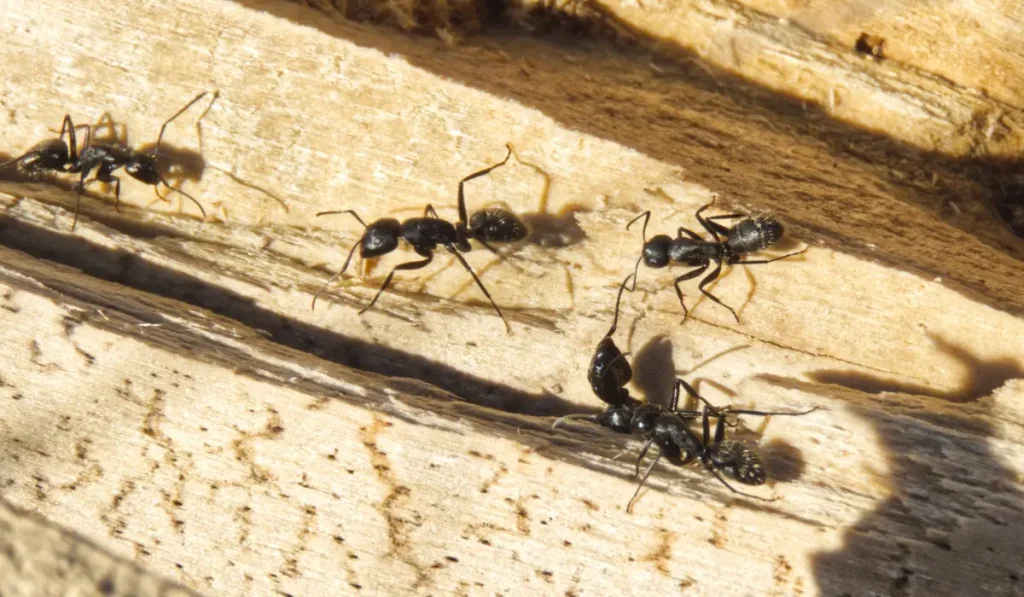
Carpenter ants in Georgia excavate wood to build nesting galleries, and repeated activity around damp or deteriorated wood can point to a hidden colony and a moisture problem. Metro Atlanta homeowners should pay attention to large dark ants, coarse frass near wood, recurring trails, and winged ants indoors. The key is to identify the insect correctly, find where the colony is active, and fix the water or wood condition that may be helping it stay there.
Why Carpenter Ants in Georgia Can Signal a Moisture Problem
Carpenter ants are drawn to wood that gives them suitable nesting space, and damp or partly decayed material can be easier to excavate. The Rutgers New Jersey Agricultural Experiment Station notes that new carpenter ant queens commonly establish nests in moist or partially decayed wood.
Around a house, recurring ant activity near damaged trim, porch components, framing, or other damp wood is worth investigating. The insects may be the first visible clue that water has been reaching an area homeowners rarely inspect.
Damp wood is a clue, not a requirement. Carpenter ants can also occupy existing cavities and other protected spaces. Repeated ant activity becomes more useful diagnostically when it appears alongside staining, soft wood, recurring leaks, or other signs of moisture.
Where to Check for Moisture Around a Metro Atlanta Home
Start with places where water can reach wood repeatedly. Leaking plumbing, roof or flashing problems, overflowing gutters, poor drainage, and wood-to-soil contact can keep structural or exterior wood wet.
Pay particular attention to:
- Window and door framing
- Porch posts and trim
- Fascia and siding below problem gutters
- Crawlspace framing
- Floor joists near plumbing
- Roof edges and flashing
- Exterior wood near soil or persistent drainage problems
Shaded areas and dense landscaping can also make wet or damaged wood harder to see during routine maintenance. If carpenter ants keep returning to one side of the house, inspect the wood and water conditions there rather than treating the ants as an isolated problem.
How to Identify Carpenter Ants in Georgia
Carpenter ants are relatively large ants, although size varies among workers. Depending on the species and individual, they may appear black, reddish-black, or bicolored. Their antennae are elbowed, and the body narrows noticeably at the waist.
Worker ants are wingless. Winged ants are reproductive members of a colony, so finding flying ants in Georgia indoors calls for closer identification because termite swarmers can look similar at first glance.
Color alone is not enough. A stronger identification comes from the insect’s body shape, repeated activity, the location where it appears, and evidence around the wood.
Signs of a Carpenter Ant Nest
Frass is one of the more useful clues. As carpenter ants expand their galleries, they can push coarse wood particles and other nest debris out through small openings. A pile that returns beneath trim, a window frame, or another wooden feature is worth tracing.
Other signs include:
- Large ants repeatedly entering the same crack or opening
- Coarse wood debris that reappears after cleanup
- Winged ants emerging indoors
- Galleries exposed during repair work
- Consistent ant trails leading toward one structural area
- Activity concentrated near damp or deteriorated wood
One isolated worker does not identify the nest. A recurring pattern of ants, debris, and activity around the same structural area gives an inspector much more to work with.
Carpenter Ants vs. Termites: How to Tell the Difference
Carpenter ants and termites can both turn up around damaged wood, but they affect it differently. Carpenter ants hollow out nesting galleries. Termites consume cellulose-containing material as food.
The University of Maryland Extension identifies several useful differences between ants and termite swarmers.
| Feature | Carpenter Ant | Termite Swarmer |
| Antennae | Elbowed | Relatively straight |
| Waist | Narrow and pinched | Broad |
| Wings | Front pair longer than rear pair | Front and rear wings similar in size |
| Relationship to wood | Excavates nesting galleries | Consumes cellulose-containing material |
| Wood evidence | Clean galleries and excavated debris | Wood removed through feeding |
Why the Difference Matters
Flying insects around a window or damaged wood do not identify the pest by themselves. Carpenter-ant inspections focus on galleries, moisture, trails, and possible parent or satellite nests. Termites in Georgia require a different evaluation because they feed on the wood rather than use it only as nesting space.
If you are unsure which insect you found, a clear photograph or safely collected specimen can help with identification before treatment begins. Correct identification prevents time from being spent on the wrong problem.
What Carpenter Ant Damage Looks Like
Carpenter ant damage consists of galleries cut into wood. The passages tend to look relatively smooth and clean because workers carry excavated material out of the nest.
Sometimes the evidence is visible as coarse debris beneath a small opening. In other cases, carpenter ant damage stays hidden inside trim, framing, wall voids, or other wooden components until repair work exposes it.
Moisture can complicate the picture. Wood may already be soft or deteriorated before carpenter ants move in, so finding a colony does not mean the ants caused every bit of damage. Inspecting the wood condition and identifying the source of moisture are both part of understanding what happened.
Damage Can Develop Before You Notice the Colony
A carpenter ant colony may be established well before winged ants or obvious gallery damage get a homeowner’s attention. Rutgers reports that a newly founded colony may take roughly three to six years to mature.
That timeline is useful for understanding why a sudden appearance of winged ants does not necessarily mean the colony is new.
The longer an active nest goes unnoticed, the more time workers have to enlarge galleries. When the same wood is also being affected by a leak or drainage problem, both issues need attention.
Why Finding the Carpenter Ant Nest Matters
The worker on your kitchen counter may not be nesting anywhere near the kitchen. Carpenter ants leave the colony to forage, and Rutgers reports that they may travel more than 100 yards from a nest.
That distance changes how you should interpret an indoor sighting. Ants may be coming from another part of the house, a porch, an outdoor tree, or a satellite nest rather than the wall next to the spot where you found them.
Surface activity can therefore send homeowners in the wrong direction. The useful clues are recurring trails, repeated emergence from one opening, frass that keeps returning, and activity that can be followed back toward a nesting area.
Parent Nests and Satellite Nests
Carpenter ant colonies can include a main parent nest and separate satellite nests. A satellite nest may develop away from the original colony, including inside a structure when suitable space is available.
That structure explains why carpenter ants can appear in several parts of a property. Workers may move between food, an indoor satellite nest, and an outdoor parent colony.
Treating only the ants moving across a visible surface may reduce activity without reaching either nest. Locating the nesting areas is what turns a short-term reduction in workers into actual colony control.
Why Metro Atlanta Homes Can Develop Carpenter Ant Problems
Carpenter ants benefit from property conditions that leave wood damp or protected. Around Metro Atlanta homes, common trouble spots include trim repeatedly soaked by a failing gutter, damp crawlspace framing, roof or plumbing leaks, poorly drained areas beside the foundation, and exterior wood that stays wet.
Landscaping can make those conditions harder to notice. Dense shrubs against siding can block inspection, while old timbers, stacked wood, and wood-to-soil contact create sheltered areas close to the structure.
None of these conditions confirms carpenter ants. They simply tell you where to look when large ants, frass, or recurring trails are already present.
How to Make Your Home Less Favorable to Carpenter Ants
Start with water. Repair leaking gutters, plumbing problems, roof leaks, flashing defects, or drainage issues that repeatedly wet wood. If the wood has deteriorated, repair or replace it as needed after the moisture source is corrected.
Keep exterior surfaces accessible enough to inspect. Trim back vegetation that hides damp siding or wood trim, and avoid keeping firewood or other stored wood against the house when practical.
These changes make the property less favorable for future nesting, but they do not automatically remove a colony that is already established.
Fixing Moisture Does Not Replace Colony Treatment
Drying out a problem area removes one condition carpenter ants may be using, but existing galleries or satellite nests can remain active. The colony still needs to be located and addressed.
The reverse applies as well. Killing visible workers while water continues to damage the wood leaves the underlying property condition unresolved.
Effective carpenter ant control starts with identification and nest location, while leaks, drainage problems, and damaged wood also need to be corrected.
When Carpenter Ants Need Professional Treatment
A professional inspection makes sense when large ants keep appearing indoors, frass returns after cleanup, winged ants emerge inside, or workers repeatedly use the same wall, trim gap, window frame, or other structural opening. Damp or deteriorated wood near the activity makes the inspection more pressing.
Smart Solutions evaluates pest activity, possible entry points, moisture conditions, structural vulnerabilities, and areas where ants may be nesting. Carpenter ants are treated as a specialized pest service, so the response can be based on where the colony is active rather than on the visible trail alone.
That inspection can help separate a few foraging ants from a colony associated with the structure and identify whether moisture repairs, wood repairs, nest treatment, or a combination of steps is needed.
Fix the Moisture and Address the Carpenter Ant Colony
Carpenter ants in Georgia can expose two problems at once: an active colony and wood conditions that make nesting easier. Repeated ants, frass, winged reproductives, or activity around damp wood are reasons to inspect both.
Smart Solutions Wildlife Removal and Pest Control can inspect carpenter ant activity, moisture conditions, entry points, and likely nesting areas around Metro Atlanta homes. If the activity keeps returning or you are unsure whether you have carpenter ants or termites, contact Smart Solutions to request an inspection and determine the right next step.




