
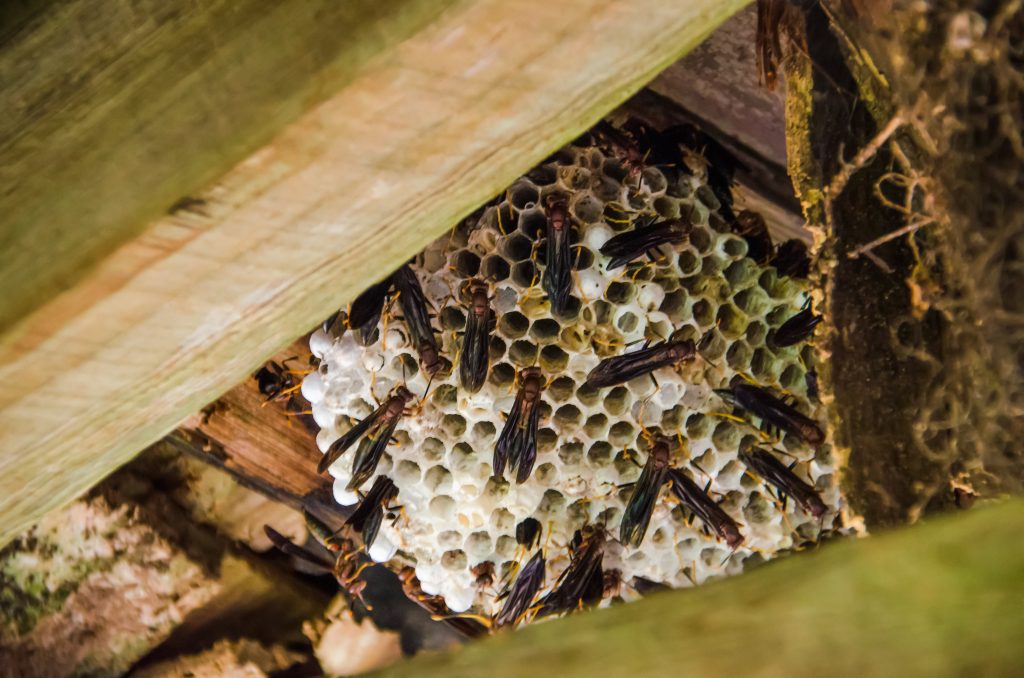
You step outside to water the plants and notice a small gray nest tucked beneath the eaves. A week later, it’s noticeably larger, and several wasps are flying in and out throughout the day. That activity isn’t random. If you’re wondering why wasps build nests on houses, it’s usually because your home provides the shelter, protection, and nearby resources they need to establish a colony.
Wasps don’t choose nesting locations at random. Certain structural features make some homes more attractive than others. In this article, you’ll learn what draws wasps to houses in Roswell, where they’re most likely to build nests, and how to make your property less appealing to future colonies.
Key Takeaways About Wasp Nests on Houses
- Wasps choose houses because exterior surfaces like soffits, fascia, vents, and eaves offer sheltered spots for building nests that are protected from rain and wind.
- Wasp colonies are annual, meaning a nest is active for only one season, but new nests can appear in the same areas year after year if conditions remain favorable.
- Nests built near doorways, walkways, or other high-traffic areas around your home raise the risk of stings and may call for professional removal.
- Preventive treatments on exterior nesting surfaces can help discourage wasps from returning, and leaving a treated nest in place for several days allows foraging wasps to contact the treatment before the nest is removed.
How to Identify Wasp Nests on Your House
Wasps choose nesting locations based on shelter, proximity to food, and structural features that support nest attachment. Houses offer overhangs, eaves, soffits, and wall voids that provide exactly those conditions. Understanding which species you are dealing with helps you know where to look and what kind of nest site to expect.
Why Wasps Choose Certain Areas of a House
Wasps typically look for locations that stay dry, protected, and undisturbed. Roof overhangs, soffits, fascia boards, deck ceilings, and covered porches provide shelter from rain and wind while offering a stable surface for nest attachment.
These areas also experience less foot traffic than doors, walkways, and patios, making them safer locations for a developing colony.
How to Tell Different Wasp Nest Types Apart
Several species may nest on or near your home. Paper wasps build open, exposed comb nests that hang from a single stalk under eaves, awnings, or deck bottoms. Bald-faced hornets are a large black and white species that build familiar large, grayish, pear-shaped nests typically suspended in trees or on the sides of buildings. The thick paper envelope of a bald-faced hornet nest encloses two or four horizontally arranged combs.
Bald-faced hornets have white and black coloring, with white coloring on the face. They are related to other yellowjacket species and build paper nests above ground, often in trees. Yellowjackets, by contrast, include several species, and most build subterranean nests in areas such as creek banks, lawns, and garden and flower beds.
How to Spot Wasp Activity Inside Your Home
Wasps can enter living spaces through exhaust vents, chimney flue pipes, and gable openings. You may notice individual wasps flying inside, especially near windows or light sources. Overwintering wasps sometimes appear in attics and crawlspaces, drawn toward warmth as temperatures drop.
Repeated wasp activity indoors may indicate a nest hidden inside a wall void, attic, or vent opening. Avoid disturbing suspected nesting sites, especially if wasps are regularly entering and exiting the same area.
Exterior Entry Points Wasps Use
Wasps commonly enter structures through gaps around vents, soffits, and fascia boards. Exhaust vents and chimney flue pipes are frequent entry points that lead to interior nesting. Gaps in gable areas and around A/C unit penetrations can also provide access.
Ground-nesting species can be difficult to spot because the entrance may be hidden beneath grass, mulch, or leaf litter. According to the Mississippi State University Extension, yellowjackets and other social wasps may defend the area around a nest entrance when the colony is disturbed. If you notice repeated wasp activity near the ground, avoid disturbing the area until the nest location has been identified.
Why Wasp Nest Problems Develop in Roswell Homes
Most wasps choose nesting locations that provide shelter, protection from the elements, and easy access to food sources. Many of the features that make a house comfortable for people also create suitable nesting areas for developing colonies.
Outdoor Nesting Areas for Wasps
Social wasps build paper nests in areas that provide overhead cover and a stable attachment point. A colony consists of an egg-laying queen and many sterile female workers, all tied to a single paper nest. Soffits, fascia, awnings, deck bottoms, handrails, vents, and gable areas are common attachment sites on homes.
Food and Shelter That Attract Wasps to Your Home
Paper wasps are beneficial caterpillar predators, and structures near gardens or landscaping can draw them closer to your home. Sheltered voids such as attics, crawlspaces, exhaust vents, and chimney flue pipes also provide protected nesting spots that wasps may move into during the season.
Why Roswell Homes Attract Nesting Wasps
Many Roswell homes feature covered porches, roof overhangs, decks, and landscaped yards that provide ideal nesting conditions for paper wasps and other social species. Properties with nearby gardens, wooded areas, and outdoor gathering spaces can also attract the insects wasps feed on.
When shelter and food sources are available in the same area, wasps are more likely to establish colonies nearby.
How Wasps Move Around Homes
Wasp colonies last for a single season, but that doesn’t mean the same areas won’t attract future nests. If a location continues to provide shelter and protection, a new queen may choose a nearby spot the following year.
Risks From Wasp Nests on Houses
Nests close to daily foot traffic raise real concerns. Understanding the risks helps you decide when a nest can be left alone and when it needs to go.
Health Risks Linked to Wasp Nests on Houses
The primary health concern is the likelihood of a sting. Paper wasp nests built in high-traffic spots put you and anyone nearby at risk each time you step outside, open a door, or work in the yard. According to Mississippi State University Extension, nests in the wrong place that are likely to cause stings need to be addressed before the colony grows.
Social wasps can sting more than once, and nests near entryways, porches, or eaves raise the odds of an unexpected encounter. Even routine tasks like mowing or painting can disturb a colony tucked under a soffit or along a handrail.
Property Damage From Wasp Nests
While wasps are not wood-destroying pests in the same way termites are, colonies that establish themselves in or around structures can become a persistent nuisance. Nests attached to soffits, fascia, gable areas, and vents may interfere with maintenance and ventilation. Overwintering wasps can also move into attics and crawlspaces, creating ongoing activity inside your home’s void spaces.
Food Areas and Wasp Activity
Social wasps capture insects such as flies, caterpillars, and beetle larvae, which means they patrol areas where those pests gather. Outdoor dining areas, kitchens with open windows, and covered patios can draw foraging wasps closer to your living spaces. Although social wasps are beneficial because they prey on other pests, colony removal is warranted when nests are located in areas of human activity where stings can occur.
When to Look Closer at Wasp Activity
Not every nest requires immediate action. A small colony in a far corner of your property may pose little risk. However, nests near doors, walkways, decks, exhaust vents, or A/C units deserve closer attention. Repeated wasp sightings around these areas often point to an active nest that could grow throughout the season.
According to the University of Georgia, a mistake during treatment can result in hospitalization or death from excessive stings. Proactive nest management is the safest approach. Waiting until a colony is well established makes the situation harder to handle and increases sting risk for everyone nearby.
Professional Pest Control for Wasp Nests on Houses
The size and location of a colony determine how it should be handled. Most nests should be left alone when they pose no direct risk to people. However, when a nest is in a high-traffic area or attached to the structure of your house, professional pest control is the safer route.
How to Reduce Attractants for Wasps
Limiting what draws wasps to your home can reduce the likelihood of nest establishment. Keep in mind that correct identification matters. European paper wasps are sometimes mistaken for yellowjackets because both are yellow and black, but yellowjackets are stockier, and most species build enclosed nests in the ground or in structural voids. Knowing which wasp species is present helps determine the most appropriate prevention and treatment strategy.
Because wasps can nest in structural voids, soffits, vents, and other sheltered spots, sealing or monitoring those areas can make your home less inviting. Smart Solutions Pest Control service professionals can assess your exterior for conditions that may attract nesting activity.
Why Wasp Control Starts With Inspection
Inspection is the foundation of any pest control plan for wasps. The visible activity near a vent, soffit, or eave may not reveal the full extent of a nest. In some cases, colonies develop inside wall voids, attics, or other concealed areas that are not visible from the outside.
A thorough inspection identifies the wasp species, the nest location, and entry points. Above-ground and nearly all structural colonies are best handled by professional pest control operators, according to Purdue Extension.
What to Expect During Professional Wasp Nest Treatment
Smart Solutions uses targeted products matched to the nest location. For exterior nesting on soffits, fascia, deck bottoms, handrails, awnings, vents, and gable areas, Taurus SC is applied with a FlowZone backpack sprayer. When wasps are nesting inside a chimney flue, a pressurized aerosol system delivers Cykick CS or an approved non-residual pyrethroid formula. PT 565 XLO Aerosol is applied directly into exhaust vents where wasps are nesting.
After treatment, nests are left in place for 5 to 7 days so foraging wasps return and contact the treatment. Follow-up visits include nest removal and additional spot treatments. For attics and crawlspaces, a dust application targets overwintering wasps and helps prevent void-space nesting. A/C units are shut down during attic dusting to prevent exposure to living spaces.
What to Expect From a Wasp Control Plan
Ongoing pest control for wasps may include exterior follow-up treatments with products like Demand CS or Onslaught FastCap to reinforce residual protection in high-activity zones. Taurus SC can be applied up to four times per year on exterior surfaces, giving your home recurring coverage through warmer months.
Colony size can vary significantly throughout the season, which is one reason treatment methods are tailored to the species, nest location, and level of activity present. Late summer colonies may consist of nearly a thousand workers, so protective gear and quick, efficient application are imperative during treatment. Because colony size and location vary, a professional pest control plan gives you a structured approach rather than a single visit.
Why Wasps Build Nests on Houses: Bottom Line
Wasps choose houses because exterior surfaces offer sheltered, stable anchor points for nest building. Eaves, soffits, vents, and covered overhangs provide the protection wasps need from rain and wind. Understanding where and why they settle helps you stay ahead of nest activity. For nests in hard-to-reach spots or inside structural voids, professional help is the safer route. If you need a hand with wasp nests on your home, reach out to Smart Solutions for a quote.
Frequently Asked Questions
Why do wasps keep coming back to the same spot?
Wasps often return to areas that previously supported a nest because the location still offers the conditions they prefer: overhead cover, proximity to food sources, and a surface suitable for attaching comb. Removing old nests and treating the area can discourage repeat nesting.
Is it low-risk to remove a wasp nest on my own?
Small, early-season nests may be manageable for a cautious homeowner wearing protective clothing that covers the body, face, and hands. However, large or structurally located colonies can be dangerous. Colonies deep inside a structure are often far from the visible entrance, making them difficult to reach without specialized equipment.
When are wasps most active around houses?
Activity typically increases through the warmer months as colonies grow. By late summer, some colonies may include many workers, which increases the likelihood of encountering wasps around your home’s exterior.
What makes professional wasp removal worth it?
Professional service is especially valuable for above-ground and structural colonies. A trained service professional has the protective gear and application methods needed to treat nests in voids, attics, and other difficult locations where a DIY approach can pose serious risk. Mistakes during nest treatment, particularly with aggressive species, can lead to dangerous sting incidents.




