
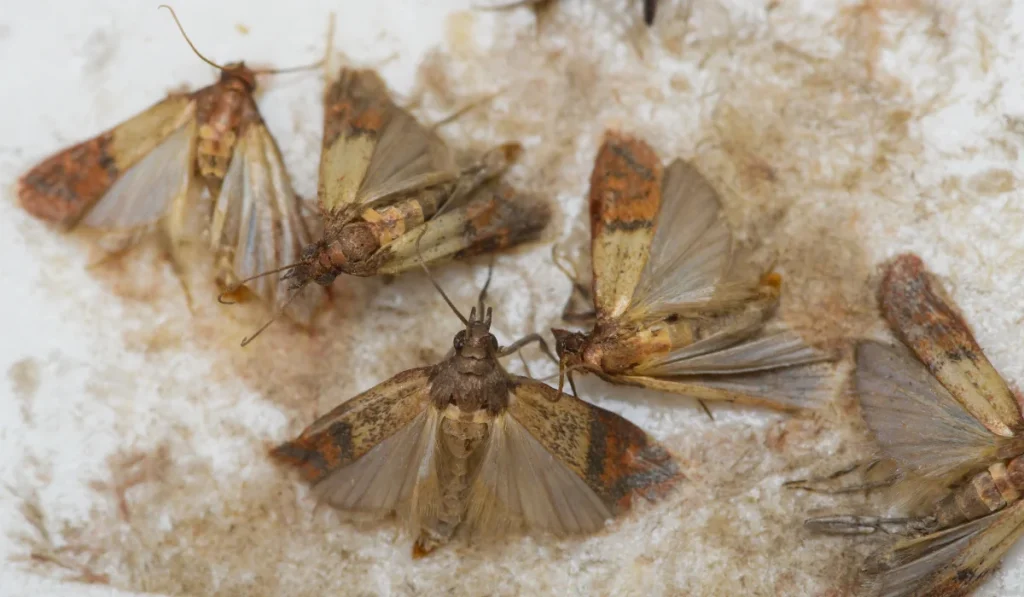
Moths in Georgia range from outdoor species that never become household pests to Indian meal moths and clothes moths that can develop inside homes. If you keep seeing moths indoors, where they appear is often your best starting point: pantry activity points toward stored foods, while activity around wool, rugs, or other natural-fiber materials can indicate clothes moths. This guide explains how to tell these situations apart, where to inspect, what signs matter, and how to address a moth infestation without treating every moth sighting as the same problem.
Common Moths in Georgia: Which Ones Matter Indoors?
Georgia is home to many outdoor moth species, and seeing one inside does not automatically indicate an infestation. The Butterflies and Moths of North America database provides identification, range, and host information for moths found across North America. For a homeowner, however, the most useful distinction is often simpler: Is the moth an occasional visitor, or is something inside your home supporting its development?
Location and repeated activity provide useful clues. A moth near a door or window may have entered from outdoors. Several small moths appearing repeatedly near food-storage areas deserve a pantry inspection. Repeated moth activity near stored wool, rugs, or similar materials calls for a closer look at fabric pests.
How To Narrow Down What You Are Seeing
| What You Notice | Likely Explanation | Where To Look Next |
|---|---|---|
| An occasional moth near doors, windows, or exterior lights | Outdoor moth that entered the home | Screens, doors, windows, and openings |
| Small moths around a pantry or kitchen | Indian meal moths or another stored-product pest | Dry foods, pet food, bird seed, shelves, and cabinets |
| Small moths around closets, rugs, or stored textiles | Clothes moths | Wool, fur, feathers, rugs, upholstery, and stored fabrics |
Use the table as a starting point rather than a final identification. An adult moth can move away from the place where it developed, so the next step is to inspect the materials that could support larvae.
Pantry Moths in Georgia: What To Know About Indian Meal Moths
Among indoor moths in Georgia, Indian meal moths are closely associated with stored foods. Smart Solutions identifies Indian meal moths as one of the stored-product pests its technicians encounter in Georgia homes and commercial properties. The larvae feed within food materials, so finding and removing the affected product is central to controlling the problem.
According to University of Kentucky Entomology information on Indian meal moths, foods that can be affected include grain products, nuts, seeds, dried fruit, and other stored materials. Pet food and bird seed also warrant inspection when moth activity appears nearby. This broad food range is one reason a pantry moth infestation can persist after a homeowner throws away only one suspicious package.
Why Pantry Moth Larvae Can Show Up On Walls
One confusing part of an Indian meal moth problem is finding larvae away from food. Indian meal moth larvae can leave the material where they were feeding and travel before pupating. As a result, you may notice larvae along cabinet edges, pantry walls, or other surfaces even though the original food source is elsewhere.
When that happens, work backward from the pantry rather than focusing only on the wall where you found the larva. Inspect stored products throughout the affected area, including items that have been sitting unused. Dry goods, baking ingredients, pet food, and bird seed all deserve attention when they are stored near the activity.
Removing adult moths without locating infested food does not address the source. The goal is to find the material supporting the larvae and clean the surrounding storage area thoroughly.
Clothes Moths in Georgia And The Materials They Damage
Clothes moths require a different inspection strategy. Two household clothes moths commonly covered in pest-management guidance are the webbing clothes moth and the casemaking clothes moth. In both cases, the larvae cause the material damage rather than the adult moths.
The UC Statewide Integrated Pest Management Program guidance on clothes moths associates clothes moth larvae with animal-derived materials such as wool, fur, feathers, and related natural fibers. For homeowners, that means the inspection should extend beyond shirts and coats. Wool rugs, blankets, upholstered items, stored textiles, and other suitable materials may also need attention.
What To Inspect For Clothes Moths
Start with items made from susceptible natural fibers, especially belongings that have been stored or left undisturbed. Look for larvae, silk-like material, cases, or areas of damage rather than relying only on sightings of adult moths.
A damaged sweater may be the first sign you notice, but it may not be the only affected item. Inspect nearby natural-fiber materials in the same storage area. If moths are appearing outside the closet, consider rugs, upholstered furniture, or other suitable materials in the room.
The distinction between pantry moths and clothes moths matters because cleaning the wrong area will not solve the problem. Pantry moth control centers on stored foods, while clothes moth control centers on finding and addressing affected materials.
Why You May Be Finding Moths In Your House
Recurring indoor moth activity usually calls for a source-based inspection. Pantry moths can be associated with stored products brought into the home, while clothes moths depend on suitable materials for larval feeding. Outdoor moths may simply be present indoors without establishing an infestation.
Where you see the moth is useful, but it is not definitive. Adult moths can move away from the material where their immature stages developed. A pantry moth on a kitchen wall may have come from a food package across the room, while a clothes moth may have developed in a stored textile that is not immediately visible.
Three Questions To Ask During Your Inspection
Use these questions to keep the search focused:
- Where do the moths appear most often? Activity concentrated near a pantry, closet, rug, or storage area helps narrow the possibilities.
- Are larvae or damaged materials present? Larvae, webbing, food contamination, or damage to natural fibers provide stronger evidence than an adult moth alone.
- Does activity continue after the obvious source is removed? Recurring moths can indicate that another affected item remains in the area.
This approach is more useful than treating every visible moth. Correct identification tells you where to focus your cleaning, removal, and monitoring efforts.
How To Get Rid Of Moths In A Georgia Home
How you address a moth infestation depends on the type of moth. For pantry moths, begin with the stored-food source. Inspect susceptible products, remove infested materials, and clean shelves, corners, cracks, and crevices around the affected storage area.
Smart Solutions’ documented stored-product pest process includes inspecting pantry and storage areas, removing infested products, cleaning remaining items, HEPA vacuuming pantry surfaces and crevices, and placing adult pheromone traps for monitoring. Pheromone traps can help track adult activity, but they are a monitoring tool and should not replace source removal.
Addressing Clothes Moth Activity
For clothes moths, inspect susceptible fabrics and other animal-derived materials rather than food-storage areas. Affected clothing may require laundering or professional cleaning when appropriate for the item. Smart Solutions’ clothes moth process also includes HEPA vacuuming, inspection of affected rugs and upholstered materials, and adult pheromone monitoring.
Non-washable belongings require extra care because treatment options depend on the material. Avoid applying a single DIY method to every garment, rug, or piece of furniture. When an item is valuable, delicate, or difficult to clean, use a method appropriate for that material rather than risking damage while trying to address the moths.
How To Prevent Moths In Georgia Homes From Returning
Prevention starts with the same principle as control: remove or reduce the conditions that support the larvae. In a pantry, that means paying attention to stored foods and inspecting products when moth activity appears. After an infestation, keeping food-storage areas clean makes it easier to spot new signs quickly.
For clothes moths, periodically checking susceptible natural-fiber items can help you catch activity before damage spreads to several belongings. Cleaning and properly caring for stored textiles also makes it easier to notice larvae, cases, or damaged areas that might otherwise remain hidden.
If outdoor moths are the issue rather than an indoor infestation, focus on how they are entering. Check screens, doors, windows, and other obvious openings. An occasional outdoor moth indoors calls for a different response than repeated pantry or fabric-pest activity.
When A Moth Infestation Needs Professional Control
A small pantry moth problem may be manageable when you can locate the affected food, remove it, clean the surrounding area, and monitor for further activity. Professional moth control becomes more useful when adult moths continue appearing after likely sources have been removed, larvae appear in several areas, or the source remains difficult to identify.
Clothes moth problems can also become complicated when several garments, rugs, upholstered items, or stored belongings are involved. In those cases, a professional inspection can help determine what type of moth is present and which materials require attention.
Smart Solutions’ documented moth-control procedures focus on inspection, source removal, HEPA vacuuming, targeted treatment when appropriate, pheromone monitoring, and follow-up. Stored-product pests and fabric pests are specialized services rather than pests included automatically in the standard SmartGuard plan.
Making The Right Moth Control Choice For Your Georgia Home
Understanding moths in Georgia begins with identifying what is supporting the activity. Indian meal moths send you toward stored foods, while clothes moths call for an inspection of wool, fur, feathers, rugs, and other susceptible natural-fiber materials. An occasional outdoor moth near a window requires a different response from larvae appearing in a pantry or damaged fabrics in storage.
If moths continue returning after you have inspected and cleaned the likely source areas, Smart Solutions Wildlife Removal and Pest Control can help identify the pest and determine the appropriate next step. You can also contact Smart Solutions about a recurring moth problem when the source is difficult to locate or several areas of your home are involved.




