
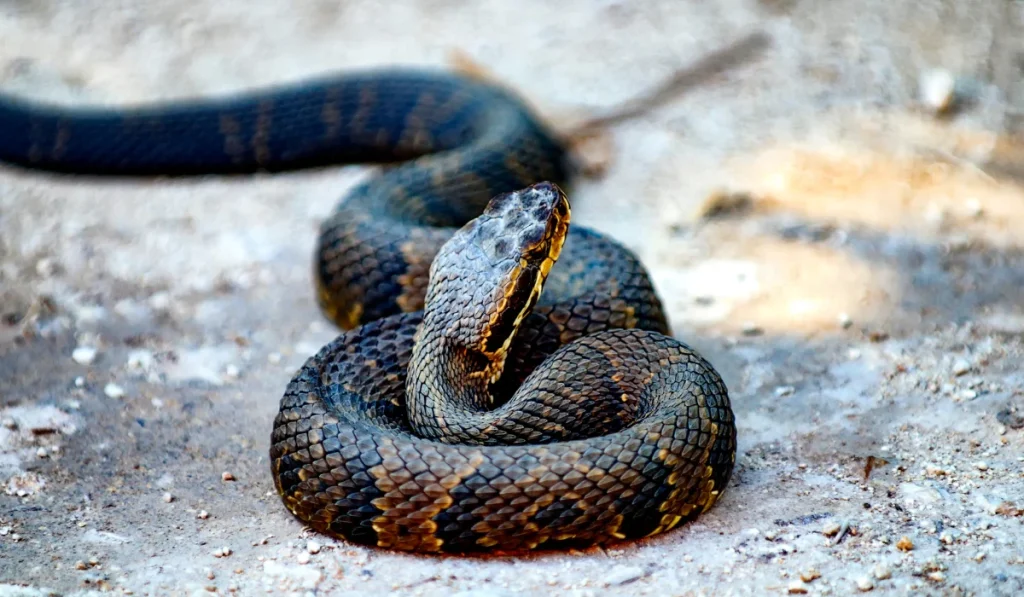
If you spot a snake near a pond, creek, wetland, or drainage area, you may wonder whether it is a water moccasin in Georgia. Water moccasin is a common name for the cottonmouth, a venomous pit viper found in parts of Georgia. Because nonvenomous water snakes can occupy similar habitats and share some visual traits, safe identification takes more than one feature. Here is how to recognize common cottonmouth characteristics, compare a cottonmouth with a water snake, respond to a suspected bite, and handle a snake around your property without getting unnecessarily close.
Are Water Moccasins Found in Georgia?
Yes, cottonmouths occur in Georgia. The Georgia Department of Natural Resources is an authoritative source for information about the state’s native snakes and other wildlife.
Cottonmouths are associated with aquatic and wet environments, but their presence varies with habitat and location. You may encounter them around wetlands, swamps, streams, ponds, marshes, and nearby land. Finding a snake beside water, however, does not automatically make it a cottonmouth.
Georgia also has nonvenomous water snakes that use similar environments. If you see an unidentified snake beside a pond, creek, drainage ditch, or other wet area, use its surroundings as context rather than as your only identification clue.
What Does a Water Moccasin in Georgia Look Like?
A water moccasin in Georgia may have a heavy body and visible crossbands, although its appearance can change with age and individual coloration. Some adults become dark enough that the body pattern is difficult to see clearly.
The name “cottonmouth” refers to the pale lining inside the snake’s mouth. A cottonmouth may open its mouth during a defensive display, exposing that light interior. It will not necessarily do so every time it encounters a person, so the absence of an open-mouth display does not identify a snake as harmless.
Several commonly repeated identification shortcuts can create false confidence. Head shape, for example, should not be used by itself. Some nonvenomous snakes flatten the head and neck when defensive, making the head appear wider than it does when the snake is relaxed.
What Do Juvenile Cottonmouths Look Like?
Young cottonmouths often show more distinct body markings than darker adults. Juveniles may also have a yellowish or greenish tail tip, which gives them a noticeably different appearance from some mature cottonmouths.
That age-related variation is one reason color alone is not enough for identification. A patterned juvenile and a dark adult can look quite different even though both are cottonmouths.
If you want help identifying a snake, stay well away from it. A clear photo taken from a safe location can provide useful details without requiring you to inspect the animal at close range.
Water Moccasin vs. Water Snake: How Can You Tell the Difference?
A water moccasin vs. water snake comparison is useful because Georgia’s nonvenomous water snakes can be mistaken for cottonmouths. Cottonmouths are venomous pit vipers, while water snakes in the genus Nerodia are nonvenomous.
The two groups can overlap in habitat, and both can show bands, blotches, or dark coloration. Both may also defend themselves if they are cornered or handled. That means no single behavior or visible feature should be treated as a foolproof test.
| Feature | Cottonmouth | Nonvenomous Water Snake |
|---|---|---|
| Venom | Venomous | Nonvenomous |
| General build | Often heavy-bodied | Varies by species |
| Body pattern | Crossbands may become difficult to see on darker adults | Often bands or blotches, depending on species |
| Defensive behavior | May remain still, flee, gape, or strike | May flee, flatten the head, or strike |
| Safest approach | Observe from a distance | Observe from a distance |
Why Head Shape Is Not Enough
A broad or triangular-looking head is often presented as an easy way to recognize a venomous snake. In practice, head shape can be misleading because nonvenomous snakes may flatten their heads when alarmed.
Pupil shape and facial features are also poor homeowner identification tools. Even when those traits have identification value, seeing them clearly requires you to be much closer to the snake than necessary.
Swimming posture is another characteristic that should be considered only as supporting information. Instead of trying to prove what the snake is while standing nearby, give it space and treat it as unidentified when you are unsure.
Where Do Water Moccasins Live in Georgia?
Cottonmouths are semi-aquatic snakes associated with wet habitats. In Georgia, suitable cottonmouth habitat can include wetlands, marshes, swamps, streams, pond edges, and areas around slow-moving water.
Semi-aquatic does not mean a cottonmouth stays in the water at all times. These snakes can travel over land, including between areas that provide water, shelter, and prey. As a result, a cottonmouth encountered away from the immediate shoreline is not automatically out of place.
Around homes and businesses, several property conditions can also provide shelter for snakes in general. Wood piles, brush piles, thick vegetation, and areas with rodent or insect activity are among the conditions Smart Solutions evaluates during snake inspections. The company’s snake-control process also looks for possible den areas, travel zones, food sources, and structural entry points.
Are Water Moccasins Aggressive or Dangerous?
Cottonmouths are venomous, so you should give one plenty of space. That does not mean behavior alone can tell you what species you are looking at.
A cottonmouth may stay still, move away, expose the pale lining of its mouth, or strike when it feels threatened. A nonvenomous water snake can also act defensively if it is restrained or cornered. Trying to provoke a response to “test” the species creates risk without giving you a dependable identification.
Your distance from the snake matters more than determining exactly how defensive it appears. Do not attempt to pick up, pin, corner, or move an unidentified snake yourself.
If a suspected cottonmouth is in a garage, beside a doorway, under a deck, or in another area where people or pets need to pass, keep the area clear until the snake leaves or a trained wildlife professional can address it.
What Should You Do if a Water Moccasin Bites You?
A suspected cottonmouth bite requires immediate medical attention. The CDC’s venomous snake guidance advises seeking emergency care after a venomous snakebite rather than relying on home treatment.
After a bite:
- Move away from the snake so another bite cannot occur.
- Seek emergency medical care as soon as possible.
- Remove rings, watches, or other tight items that may become difficult to remove if swelling develops.
- Follow instructions from emergency medical professionals.
Do not cut the bite wound, attempt to suck out venom, apply ice, or use a tourniquet. Do not try to capture or kill the snake for identification because doing so creates another opportunity for a bite.
Poison Control also provides guidance for venom exposures. Medical professionals should evaluate the bite and determine the appropriate treatment based on the circumstances and your symptoms.
What Should You Do if You Find a Water Moccasin on Your Property?
If you think you have found a water moccasin in Georgia, your first response should be to create distance. Keep children and pets away, and do not block the snake if it has a clear route out of the area.
A snake crossing a quiet part of the yard may leave on its own. A snake inside a building or close to a doorway, garage, patio, play area, or other frequently used space presents a different problem because avoiding the area may not be practical.
Do not attempt to move the snake with a rake, shovel, stick, or similar tool. These methods put you close to an animal that may defend itself.
What Professional Snake Control Can Address
Smart Solutions’ snake-control process begins with an inspection of the structure and surrounding property. Depending on what the technician finds, the plan may involve:
- Snake trapping and removal
- Identifying travel routes and possible den areas
- Structural exclusion where snakes are entering a building
- Habitat modification around brush piles, wood piles, and other shelter
- Snake barriers where appropriate
- Reducing food sources such as rodents and insects
These services reflect the company’s documented snake-control process rather than a one-size-fits-all treatment.
Smart Solutions also advises against relying on mothballs for snake control. Instead, a property-specific plan focuses on the animal, its access routes, shelter, and food sources.
How Can You Reduce Snake Activity Around Your Georgia Home?
A good prevention plan focuses on the conditions that make parts of your property useful to snakes. You cannot make an outdoor property completely inaccessible to wildlife, but you can reduce common sources of shelter and prey.
Reduce Hiding Places
Keep brush and debris from accumulating close to the house. Move firewood piles away from the structure, and manage dense vegetation around foundations and other frequently used parts of the yard.
These changes also make it easier to see what is happening around your property. A snake moving through an open, maintained area is easier to notice than one concealed beneath thick ground cover or a pile of unused materials.
Address Food Sources
Snakes go where they can find suitable habitat and prey. Smart Solutions includes rodent and insect activity among the food-source conditions evaluated during snake-control work.
If you are seeing rats, mice, chipmunks, or heavy insect activity around the same areas where snakes appear, addressing those pest issues can form part of a broader wildlife-management plan.
Check Structural Access Points
A snake outdoors is different from a snake entering a garage, crawlspace, or other part of a building. When indoor activity is occurring, an inspection can help identify gaps or other access points that need to be addressed after the animal issue has been resolved.
Smart Solutions may use exclusion as part of a snake-control plan when a structure has entry points that snakes can use. The exact work depends on the property, the location of the activity, and the type of snake involved.
Handling a Water Moccasin Concern Safely in Georgia
When you encounter a possible water moccasin in Georgia, you do not need to get close enough to prove the identification. Cottonmouths are venomous, nonvenomous water snakes can look similar, and either type of snake may defend itself when handled or cornered. Give the animal room, keep people and pets away, and seek medical care immediately if a bite occurs.
If a snake is inside your home or repeatedly appearing around areas your family uses, Smart Solutions Pest and Wildlife Removal can inspect the property for snake activity, shelter, food sources, and potential entry points. To arrange an inspection or discuss a snake-removal concern, contact Smart Solutions for help with the next steps.




